Stupid Ludmila
The Painted BirdStupid Ludmila is a forest-dwelling woman whom the village reduces to a mocking nickname, even though her story includes forced marriage arrangements, sexual violence, and the loss of her family ties. Her bond with Lekh offers a rare relationship of tenderness and recognition, but it cannot protect her from the community’s violence: after he is absent, she is killed by village women.
Identity and Background
The unnamed boy narrator first encounters Stupid Ludmila through descriptions that make her seem both conspicuous and elusive. She is taller and more powerfully built than the other women, with long, uncut hair, and wears a faded sack in summer. Men and boys circulate stories about their encounters with her, while village women try to catch her. Yet these accounts are not the same as an account of her past: they turn her into a local spectacle, defined by her body and by what others claim about her.
Lekh offers a different history. When Ludmila was young, her parents arranged her marriage to the son of the village psalmist, a man Lekh describes as cruel. She refused. Her fiancé then lured her beyond the village, where a group of drunken peasants raped her. Lekh says that she was changed afterward and that her mind became addled. With no one remembering her family, the community gave her the name Stupid Ludmila. The account connects the nickname to a history of violence and abandonment rather than treating it as a neutral description of her character.
Afterward, she lived in the forest and drew men to her. The village’s stories about her include fantasies that she lived with her enormous dog as with a man and might bear monstrous children. These tales blur what the villagers claim with what they know, and make her a figure of supposed wildness. The contrast is stark: her life is narrated by other people, while the history that might explain it survives through Lekh’s account.
The Forest and Lekh
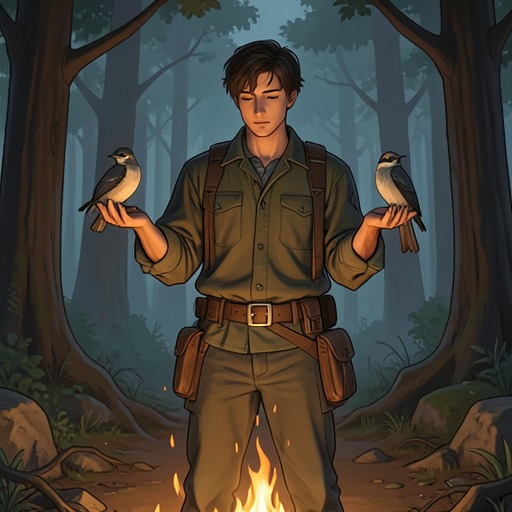
Lekh does not repeat the village’s stories about Ludmila. He loves her, makes tender songs in which she appears as a strangely colored bird traveling to distant worlds, and imagines her as belonging to a realm of forests and abundance beyond ordinary human society. This idealization is his, not a direct account of how Ludmila understands herself. Still, it distinguishes his regard from the village’s ridicule and fear.
Their meetings follow a daily pattern. At noon, Lekh and the boy walk to a clearing where Lekh hopes to find her. He calls by hooting like an owl; Ludmila rises from the tall grass with bluebottles and poppies tangled in her hair. Lekh hurries to her, and the two stand swaying together among the grass. The boy watches from behind ferns. Birds in his bag stir at the sudden quiet, while the couple touch and kiss. The scene places their intimacy in the landscape, partly concealed from the boy’s gaze, and contrasts their closeness with the stories that reduce Ludmila to a village scandal.
Lekh later says that Ludmila tells him about her life and suffering during their time together, including the unusual turns of her feelings. The narrative therefore gives her personal history indirectly: the boy witnesses her meetings with Lekh, but hears her disclosures through Lekh afterward. Her inner life is present, but mediated by the people who surround her.
Separation and Death
After weeks pass and the forest grows more desolate, Ludmila appears at Lekh’s cabin with her huge dog. She repeatedly asks where he is. When the boy says that Lekh left many days earlier and that he does not know where he went, she alternates between sobbing and laughing. She presses Lekh’s old cap to her cheeks, then throws it down and tramples it. She drinks the vodka he left beneath the bed and orders the boy to go with her to the pasture. When he tries to escape, she uses the dog to stop him.
At the pasture, Ludmila attempts to force the boy into sexual activity. Shepherds come upon them, and their attention turns to her; the boy is disregarded. Their presence does not rescue her. More men join in abusing her, until village women arrive carrying rakes and shovels. The men leave, but the women restrain Ludmila and attack her. They also kill her dog. The boy retreats toward the cemetery wall, where fear of the spirits said to inhabit the graves keeps the watching peasants at a distance.
Lekh appears while the women are still gathered around Ludmila. He is too far away to reach her before they kill her, and they beat him when he tries to intervene. Once the women leave, he rises injured, approaches Ludmila’s body, crosses himself, and sobs. The boy remains on the cemetery wall as night falls. In the final image, the moonlight reveals Lekh kneeling beside the dead woman. Their separation, temporary in the earlier scenes, becomes irreversible.
Narrative Role and Significance
Ludmila’s story sets competing ways of seeing her against one another. The villagers make her an object of rumor, sexualized attention, and punishment; Lekh imagines her as a free, vivid presence in the forest; the boy watches her from the edges of their encounters. None of these perspectives gives her sustained control of the narrative, but Lekh’s account of her past and her reported conversations prevent the village nickname from being the only explanation offered for her life.
The sequence also turns the apparent safety of the forest into a fragile refuge. Ludmila and Lekh meet there beyond the ordinary village gaze, yet the meadow becomes the site of her final persecution. Her death follows the earlier violence that changed her life, while the community’s collective attack makes clear that she remains exposed to forces larger than any one relationship. Lekh’s return can restore his presence but not undo his absence or save her. The ending leaves the boy as witness to a death he cannot prevent and to a grief that the village’s stories had concealed.